Digital Waste Tracking: API integration guidance
Status: draft outline, v1.0
Owner: Dave Oliver
Contents
- 1. Introduction
- 2. Service overview
- 2.1 Lifecycle stages
- 2.2 Actors
- 2.3 Core identifiers
- 3. API reference
- 4. Business rules and data reconciliation
- 4.1 Collection cardinality
- 4.2 Movement-to-delivery cardinality
- Appendix A: glossary
- Appendix B: endpoint quick reference
1. Introduction
This document provides guidance for software providers building producer, broker, carrier/driver or receiver-facing systems that will interact with Defra's dedicated API to record waste movements.
2. Service overview
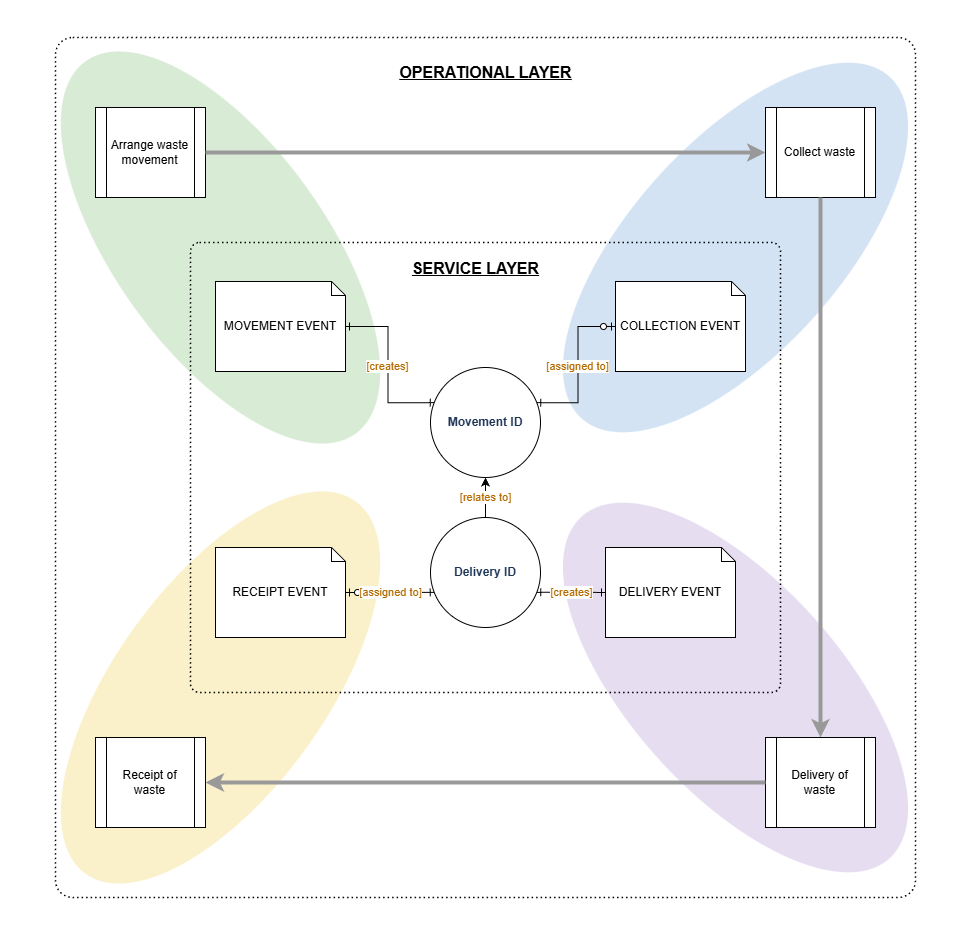
2.1 Lifecycle stages
The API is organised around four stages:
| Stage | What happens |
|---|---|
| Creation | Movement created; estimated details declared; Movement ID generated |
| Collection | Carrier/driver records the collection against a Movement ID |
| Delivery | Driver records delivery and declares the Movement ID in scope; Delivery ID generated |
| Receipt | Receiving site records acceptance of the waste against the Delivery ID |
2.2 Actors
- Producer / Controller (EA term) – the organisation whose waste is being moved
- Broker / Controller (EA term) – arranges the movement on behalf of a producer or receiver
- Carrier / Transporter (EA term) – the organisation licensed to transport the waste; may operate through a Driver as the field-level user recording events in real time
- Receiver – the site accepting the waste for treatment, disposal or recovery
2.3 Core identifiers
- Waste Movement ID –
movementIdis the primary record of an intended waste movement, created before the waste moves - Waste Delivery ID –
deliveryIdis the record created at delivery; a single Delivery ID can bundle one or more Movement IDs together
3. API reference
You can see the current API spec at: Digital Waste Tracking OpenAPI specification.
The spec will update with each milestone in the development process – expect some shapes to shift before go-live.
4. Business rules and data reconciliation
4.1 Collection cardinality
One collection entry per physical collection event, even where loads are later combined at delivery.
4.2 Movement-to-delivery cardinality
Many Movement IDs can be linked to a single Delivery ID at delivery; a Delivery ID always originates from exactly one delivery event.
Appendix A: glossary
| Term | Meaning |
|---|---|
| DWT | Digital Waste Tracking – the digital service this API supports |
| EA | Environment Agency |
| EWC | European Waste Catalogue – the code list used to classify waste type |
| HWCN | Hazardous Waste Consignment Note – the paper record DWT replaces for hazardous waste |
| POPs | Persistent organic pollutants – chemicals subject to additional handling and reporting rules |
| Waste Movement ID | Identifier issued when a movement is created, before waste moves |
| Waste Delivery ID | Identifier issued at delivery; can link multiple Movement IDs together |
| WTN | Waste Transfer Note – the paper record DWT replaces for non-hazardous waste |
Appendix B: endpoint quick reference
| Method | Path |
|---|---|
| POST | /movements |
| POST | /movements/{movementId}/collection |
| POST | /deliveries |
| POST | /deliveries/{deliveryId}/receipt |